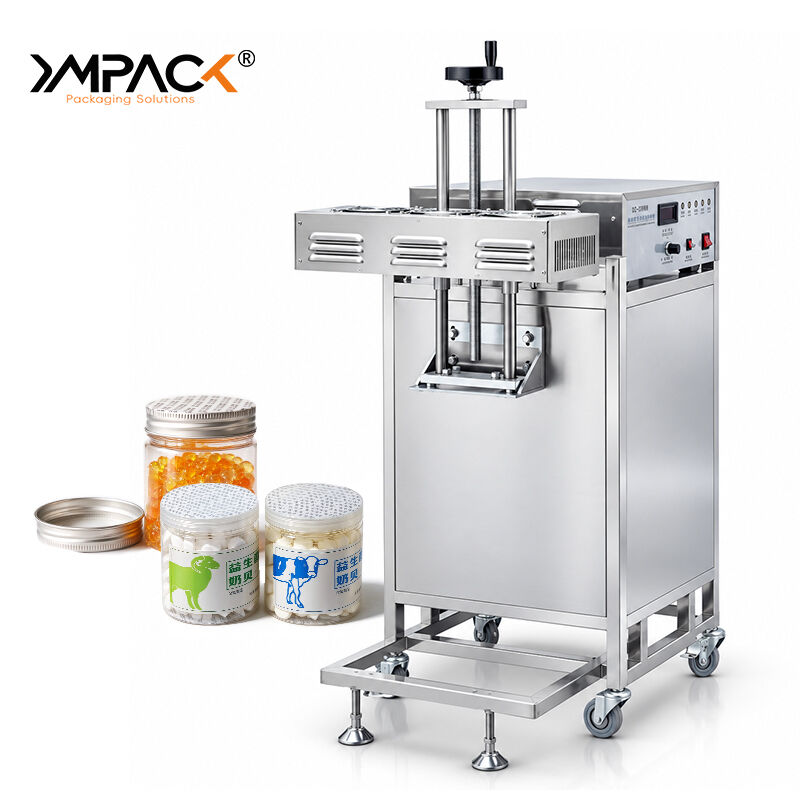
LM2000 Aluminum Foil Induction Sealing Machine — Non-Contact Cap Sealer for Plastic & Glass Bottles
LM2000 aluminum foil induction sealing machine for plastic and glass bottles. Non-contact, hermetic, tamper-evident sealing for food, pharma, cosmetics, and chemical packaging. Factory-direct, CE certified, OEM/ODM available.
The LM2000 Aluminum Foil Induction Sealing Machine is a non-contact cap sealing system that bonds aluminum foil liners to plastic and glass containers using electromagnetic energy rather than heat, pressure, or adhesive. It is the core sealing solution for packaging operations that need a hermetic, tamper-evident membrane on every container — produced consistently, at line speed, without any heated tooling ever touching the product.
Induction sealing has become the default choice in regulated and premium packaging categories for one reason: it protects the product without interfering with it. The energy that forms the seal is generated inside the cap, in the foil liner itself. The container wall, the cap shell, and the contents are simply passed through by the electromagnetic field. Nothing is pressed, nothing is heated from outside, and nothing is added to the package. What remains is a clean foil membrane fused to the container rim — the most widely accepted tamper-evident and barrier seal available.
The LM2000 is engineered for manufacturers and contract packers working across food, beverage, pharmaceutical, nutraceutical, cosmetic, and chemical categories, sealing PET, HDPE, LDPE, PP, PS, PVC, and glass containers with cap openings from 20 mm to 130 mm. Standard sealing heads cover the common bottle formats in these industries; custom coils are available for non-standard diameters and specialty cap geometries.
What separates the LM2000 from the broader field of induction sealers is its balance of capability and simplicity: continuous automatic operation, stable power regulation across real-world electrical conditions, a forced-air cooling architecture that requires no water infrastructure, and full factory-direct configurability at the point of order — voltage, sealing diameter, conveyor dimensions, and control interface.

Core Specifications
| Parameter |
Specification |
| Model |
LM2000 |
| Sealing Method |
Electromagnetic induction (non-contact) |
| Automation Level |
Automatic, continuous operation |
| Cooling System |
Forced-air (no water infrastructure required) |
| Power Supply |
220V / 50–60Hz (custom voltages available) |
| Power Output |
1500W–3000W (application-dependent) |
| Operating Frequency |
70–90 KHz |
| Sealing Diameter |
20–130 mm (custom heads available) |
| Conveyor Speed |
3–12 m/min (variable frequency drive) |
| Suitable Bottle Height |
40–300 mm |
| Container Materials |
PET, HDPE, LDPE, PP, PS, PVC, Glass |
| Liner Compatibility |
Aluminum foil induction liners |
| Control Interface |
Digital power and speed adjustment with display |
| Sealing Head Adjustment |
Manual height adjustment with locking mechanism |
| Construction |
Stainless steel frame, industrial-grade components |
| Certification |
CE compliant |
| Warranty |
1–2 years (configuration-dependent) |
How It Works: The Physics Behind the Foil Seal
Induction sealing is often described as "heat sealing without heat" — a useful shorthand, but worth unpacking, because the mechanics explain why the seal is as reliable as it is.
The Liner Is the Heating Element
Inside every cap designed for induction sealing sits a laminated liner: a thin aluminum foil disc with a heat-sealable polymer layer on the face that points toward the container, and a backing material above it. This is the entire sealing mechanism. The machine does not supply heat — it supplies the energy that causes the foil to generate heat.
Electromagnetic Energy Transfer
When a capped container passes beneath the induction coil, the coil is energized with high-frequency alternating current and produces a rapidly oscillating magnetic field. That field passes through the plastic or glass container wall without interacting with it, and without affecting the cap shell. It acts only on electrically conductive material — in this case, the aluminum foil.
Eddy currents induced in the foil meet electrical resistance, and that resistance produces heat — within milliseconds. The foil, not the machine, is the heat source.
Bond Formation and Solidification
The heat generated in the foil transfers immediately into the polymer layer beneath it. When the polymer reaches its melt point, it becomes adhesive and bonds to the land — the flat rim of the container opening. The container itself is never contacted by a heated element; the energy transfer is entirely non-contact and non-invasive.
As the container clears the coil, the molten polymer cools and solidifies within seconds. The foil remains fused to the container rim, forming a continuous hermetic membrane. If the liner incorporates a release layer, it volatilizes during heating so the backing separates cleanly when a consumer opens the cap.
Product Advantages & Selling Points
1. Non-Contact Sealing: The Product Is Never Touched
Nothing heated contacts the container, the cap exterior, or the contents. For temperature-sensitive formulations — dairy, juice, probiotics, active-ingredient cosmetics, effervescent pharmaceuticals — this removes an entire class of quality risk rather than merely reducing it. It also eliminates the contamination pathways that contact sealers introduce through tooling that touches every container in turn.
2. Hermetic, Tamper-Evident Barrier
Each seal is a continuous membrane bonded to the container rim. It cannot be removed and reapplied without visible destruction, which delivers consumer assurance, brand protection against refilling and counterfeiting, and documented tamper evidence for regulated product categories.
3. Barrier Protection That Extends Shelf Life
The foil membrane blocks oxygen and moisture ingress. For food products this means retained texture, aroma, and flavor without added preservatives. For pharmaceuticals and nutraceuticals it means formulation stability through distribution. For hygroscopic powders it means the product still performs as specified when the consumer opens it months later.
4. Forced-Air Cooling: No Water, No Plumbing, No Coolant Maintenance
The LM2000 dissipates heat through forced-air cooling rather than a water loop. In practical terms that means: no pump to fail, no seals or hoses to degrade, no coolant to top up or dispose of, no algae or bacterial growth in a reservoir, and no drainage infrastructure beside your filling line. For facilities without existing water services at the packaging station, this is the difference between installing a machine and commissioning a utility project.
5. Wide Container and Cap Compatibility
The LM2000 seals PET, HDPE, LDPE, PP, PS, PVC, and glass containers, with standard sealing heads covering 20–130 mm cap openings. That range spans the bottle formats used across beverages, sauces, cosmetics, pharmaceuticals, and household chemicals, allowing one machine to serve multiple production lines or SKUs.
Problems Solved & Application Scenarios
Food, Sauce & Condiment Production
Leakage in transit is among the costliest failure modes in liquid food packaging — a single failed seal can damage an entire case. Induction sealing produces a full-perimeter bond that survives distribution and retail display, and the stainless steel construction withstands the acidic residue that accumulates around sauce filling lines.
Beverage & Liquid Food
Juices, teas, functional drinks, and liquid supplements depend on barrier protection to preserve flavor and nutritional content. Because sealing is non-contact, temperature-sensitive ingredients are not exposed to heat during the sealing step.
Cosmetics & Personal Care
Preservative-free and natural formulations are especially vulnerable to contamination and oxidation. Induction seals protect the product through the supply chain, and the clean foil membrane the consumer sees on opening reinforces the premium positioning that glass and acrylic packaging are chosen to deliver.
Chemicals & Agrochemicals
Powders, granules, and liquid formulations in this category need containment that holds through transport and storage. The air-cooled design also keeps siting simple — no water connection is needed in areas where moisture control matters.
Why Choose Us
Factory-Direct Manufacturing. We build rather than resell, which means transparent pricing without distributor layers, genuine customization at the point of order, and spare parts sourced from the original production line.
Documented Quality Control. Every unit is inspected at component level before assembly, run at full power during burn-in testing, and verified for sealing performance using sample containers before packing. Machines ship with test documentation, wiring diagrams, and an operation manual.
Application Validation Before Purchase. Container-liner-cap combinations behave differently, and the correct operating window is specific to your product. We support pre-purchase validation with your own containers and liners, so the machine arrives configured for your application rather than a generic specification.
Global Service Commitment. Warranty coverage on parts and labor, remote technical support by video call and email, on-site installation and training for volume orders, and a maintained spare parts inventory for fast dispatch. Operators receive a full documentation and video library.
Packaging Line Depth. Our engineering background spans filling, capping, labeling, and sealing, so the LM2000 is designed to integrate with the equipment around it. If you are planning a complete line, layout and configuration support is available.
FAQ
Q1: How does induction sealing differ from contact heat sealing?
Induction sealing generates heat inside the cap, in the aluminum foil liner, using an electromagnetic field. Contact heat sealing applies a heated tool directly against the container or cap. Induction sealing is non-contact, produces more consistent bonds, and eliminates the contamination and wear issues associated with heated tooling.
Q2: What container materials and cap sizes does the LM2000 support?
PET, HDPE, LDPE, PP, PS, PVC, and glass containers, with cap openings from 20 mm to 130 mm using standard sealing heads. Custom heads are available for other diameters. Metal containers and metal caps cannot be sealed with induction technology.
Q3: Does the machine need a water connection?
No. The LM2000 uses forced-air cooling for the coil and power electronics. There is no coolant reservoir, circulation pump, radiator, or drainage requirement — only an electrical connection.
Q4: How do I determine the right sealing settings for my product?
Each container-liner-cap combination has a specific operating window between minimum energy for a proper bond and maximum energy before the liner is compromised. We provide a step-by-step procedure for establishing it, and settings can be saved and recalled for repeat production.
Q5: What maintenance does the LM2000 require?
Routine maintenance is limited to inspecting the sealing head for debris, cleaning or replacing air filters periodically, and checking conveyor belt tension and alignment. There is no coolant to change and no pump to service.
Q6: Can the sealing head be changed for different cap diameters?
Yes. Standard heads cover 20–130 mm, and custom heads are available for smaller or larger diameters. Changeover is manual and typically takes under 15 minutes.
Q7: Will the machine integrate with my existing production line?
Yes. Conveyor speed, height, and control interfaces can be configured to work with upstream fillers and cappers and downstream labeling or packing equipment.
Q8: What is the lead time, and how is the machine shipped?
Lead time depends on configuration and order volume. Machines ship worldwide by sea freight for cost efficiency or air freight for urgency, professionally crated for international transport.
Q9: What support is provided after delivery?
Warranty coverage on parts and labor, remote technical support by video call and email, a documentation and video training library, and on-site installation and training for volume orders.


 Your message must be between 20-3,000 characters!