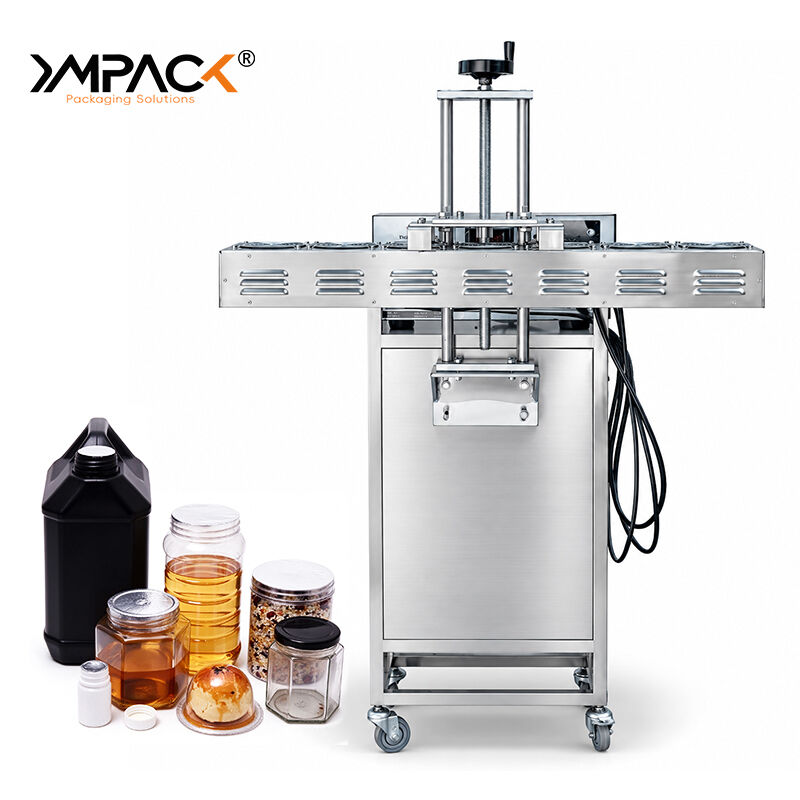
Automatic Glass Bottle Induction Sealing Machine — Aluminum Foil Cap Sealer for Beverages & Cosmetics Packaging
Automatic aluminum foil induction sealing machine designed for glass bottles in beverage and cosmetics packaging. Non-contact, tamper-evident sealing with high compatibility. Factory-direct, CE certified, global shipping available.
The Automatic Glass Bottle Induction Sealing Machine is a specialized aluminum foil sealing system engineered to meet the unique demands of beverage and cosmetics packaging operations where glass containers are the preferred format. While induction sealing technology works across all non-metallic container types, glass presents distinct challenges — and opportunities — that generic sealing equipment often fails to address adequately.
Glass bottles are non-porous, dimensionally stable, and chemically inert, making them ideal for products where flavor integrity, purity, and premium presentation are paramount. However, glass also exhibits lower thermal conductivity than plastics, meaning the sealing energy must be delivered with greater precision to achieve proper adhesion without excessive heating. The polymer sealing layer on induction liners must reach its melt point and bond to the glass rim within a narrow process window. Under-sealing produces weak, leak-prone bonds. Over-sealing degrades the liner, distorts the cap, or creates unsightly seal appearance.
This machine addresses those challenges through application-specific coil design and closed-loop power regulation. The sealing head is optimized for the dielectric properties of glass containers, ensuring efficient energy transfer through the cap and liner to the foil. The control system maintains output stability across voltage fluctuations and production speed variations, delivering the consistent energy dose that glass sealing demands.
The machine is purpose-built for manufacturers and contract packers in the beverage, spirits, wine, cosmetic, skincare, fragrance, and premium food industries who package in glass and require hermetic, tamper-evident seals that protect product integrity from filling line to consumer opening. Whether you are sealing premium liquor bottles, artisanal sauces, luxury skincare serums, or organic juices, this machine delivers the seal quality that premium glass packaging demands.
As a factory-direct offering, the machine is available with configurable sealing head diameters, conveyor dimensions, voltage options, and control interfaces to match your specific bottle formats and production requirements.

| Parameter |
Specification |
| Machine Type |
Automatic continuous induction sealer |
| Primary Application |
Glass bottles — beverages, cosmetics, spirits, food |
| Power Supply |
220V / 50-60Hz (customizable: 110V, 380V, etc.) |
| Power Output |
1800W–2800W (glass-optimized) |
| Sealing Diameter |
20–120 mm (custom heads available) |
| Conveyor Speed |
3–12 m/min (variable frequency drive) |
| Suitable Bottle Height |
40–350 mm |
| Conveyor Width |
80–180 mm (customizable) |
| Cooling System |
Forced-air, no water infrastructure required |
| Control Interface |
Digital power/speed adjustment with display |
| Sealing Head Adjustment |
Manual height adjustment with locking |
| Construction |
Stainless steel frame, industrial components |
| Certification |
CE compliant |
| Warranty |
1-year comprehensive |
Working Principle: How Induction Sealing for Glass Bottles Works
Induction sealing on glass containers follows the same fundamental physics as sealing on plastic — electromagnetic energy induces eddy currents in the aluminum foil liner, generating heat that activates the polymer sealing layer. However, the glass-specific dynamics require a more nuanced understanding.
The Energy Transfer Path
When a capped glass bottle passes beneath the induction coil, the oscillating magnetic field passes through:
-
The plastic cap shell
-
The liner backing material
-
The aluminum foil layer
-
The polymer sealing layer
-
The glass rim
The aluminum foil — being electrically conductive — absorbs the electromagnetic energy and converts it to heat. This heat must then transfer downward through the polymer layer to the glass surface. Because glass conducts heat more slowly than plastic, the energy delivery must be precisely controlled: enough to melt the polymer and create a bond, but not so much that the polymer degrades before the bond forms.
The Glass Advantage
Glass's dimensional stability is actually an asset for induction sealing. Unlike plastic containers that may vary slightly in rim flatness or wall thickness, glass rims are consistently flat and parallel, providing an ideal surface for the polymer to bond against. This means that once the correct operating window is established, glass sealing can achieve exceptionally high consistency — often better than plastic sealing for the same liner specification.
The Sealing Cycle
-
Infeed — Capped glass bottles enter the conveyor, guided by adjustable rails
-
Coil engagement — Bottles pass beneath the sealing head; the coil energizes
-
Energy delivery — Foil heats, polymer melts, bond forms at the glass rim
-
Cooling — Bottle exits the coil zone; polymer solidifies within seconds
-
Discharge — Hermetically sealed bottle proceeds to labeling or packing
The entire cycle takes 2 to 6 seconds depending on conveyor speed and bottle size, enabling throughput of 2,000 to 10,000 bottles per hour for typical glass container formats.
Product Advantages
1. Optimized for glass containers: Precise energy control
Generic induction sealers often struggle with glass because their fixed power settings are calibrated for plastic containers. This machine's glass-optimized power delivery ensures the polymer layer reaches its melt point without overheating the liner or distorting the cap. The result is a clean, consistent seal that presents professionally upon consumer opening.
2. Non-contact sealing: Protecting product integrity
Unlike contact-based heat sealers that press heated tooling against the container, induction sealing is entirely non-contact. This is particularly important for:
-
Temperature-sensitive cosmetics — serums, essences, and active-ingredient formulations
-
Premium beverages — where even brief heat exposure can affect flavor compounds
-
Products with volatile components — essential oils, aromatics, alcohol-based formulations
The container and its contents are never touched by heated surfaces, eliminating contamination risks and preserving product integrity .
3. Extend shelf life
Induction foil seals create a functional barrier between your product and the external environment. For beverages, this means extended shelf life without preservatives. For cosmetics, it ensures formulation stability through distribution channels. Comparative studies consistently demonstrate that induction-sealed glass containers outperform unsealed alternatives in accelerated aging tests, particularly for oxygen-sensitive and aromatic products.
4. Broad compatibility with glass containers
The machine seals glass containers including:
-
Beverage bottles — juice, spirits, wine, kombucha, specialty drinks
-
Cosmetic jars and bottles — creams, serums, lotions, fragrances
-
Food containers — sauces, condiments, honey, preserves
-
Pharmaceutical glass — syrups, tinctures, essential oils
Cap sizes from 20mm to 120mm are accommodated with standard sealing heads. Custom coil designs are available for non-standard diameters and specialty cap geometries including conical and recessed styles.
Problems Addressed and Application Scenarios
Beverage Industry: Quality Preservation and Transport Safety
For juices, spirits, wine, kombucha, and specialty beverages packaged in glass:
-
Leak prevention during long-distance transport and distribution
-
Freshness retention for products where aroma and flavor are key differentiators
-
Visual quality assurance — a clean, intact foil seal reassures consumers at point of purchase
-
Extended shelf life without refrigeration or preservatives
Cosmetics and Skincare: Brand Image Protection
Premium cosmetic brands cannot tolerate leakage or contamination in the supply chain. Induction seals provide:
-
Hermetic protection for natural and organic formulations without preservatives
-
Professional presentation upon consumer opening
-
Compatibility with glass and acrylic packaging used in luxury segments
-
Prevention of oxidation for active-ingredient formulations
Food and Condiments: Seal Integrity
For sauces, oils, vinegars, honey, and preserves packaged in glass:
-
Contamination prevention during storage and transport
-
Moisture and oxygen barrier properties
-
Consumer confidence through visible tamper evidence
-
Compliance with food safety regulations
Why Choose Us
Factory-direct supply; no middlemen.
As a direct manufacturer, we control every stage of production from component sourcing to final testing. This means:
-
Transparent pricing without distributor markups
-
Customization capability — voltage, sealing diameter, conveyor length, and control interfaces can be adapted to your specific requirements
-
Spare parts availability from the original production source
-
Direct technical support from engineers who understand the machine's design
Strict quality control system
Every unit undergoes:
-
Pre-assembly component inspection for critical electrical and mechanical parts
-
Full-power burn-in testing before shipment
-
Sealing performance verification with sample containers
-
Documentation package including test reports, wiring diagrams, and operation manuals
Global Service Commitment
-
1-year comprehensive warranty covering parts and labor
-
Remote technical support via video call and email
-
On-site installation and training available for volume orders
-
Spare parts inventory maintained for rapid shipment
FAQ
Q1: Can this machine seal both glass and plastic bottles?
Yes. The machine is optimized for glass containers but can also seal plastic bottles (PET, HDPE, PP, etc.) with appropriate settings. The PLC recipe system allows you to store and recall settings for different container types, making changeover between glass and plastic straightforward.
Q2: What types of caps work with induction sealing on glass bottles?
Caps must be plastic (screw-on, snap-on, or flip-top) and accommodate induction liners. Common cap types include standard screw caps, disc-top caps, and flip-top closures. Metal caps and metal containers cannot be sealed using this technology.
Q3: How do I determine the correct sealing settings for my glass bottles?
Each container-liner-cap combination has a specific operating window. We provide a step-by-step procedure for determining this window during setup. As a starting point, most glass applications run successfully at 50-70% power with conveyor speed matched to your line rate. The PLC recipe system allows you to store and recall settings for different products.
Q4: Does the machine require water cooling?
No. This machine uses forced-air cooling, eliminating water pumps, radiators, and plumbing. This reduces installation complexity, maintenance requirements, and the risk of water damage to your facility.
Q5: Can the sealing head be changed for different cap sizes?
Yes. Standard sealing heads cover 20-120mm diameters. Custom heads for smaller or larger diameters are available. Changeover typically takes less than 15 minutes.
Q6: What is the typical lead time and shipping method?
Standard configurations ship within 15-25 business days. Custom configurations may require additional time. We ship worldwide via sea freight (cost-effective for full machines) or air freight (faster for urgent orders). All units are professionally crated for international transport.
Q7: Is training provided for operators?
Every machine includes a comprehensive operation manual and video tutorial library. For volume orders, we offer on-site installation and training by our technical engineers. Remote support via video call is available for all customers.
Q8: How does induction sealing compare to shrink bands for glass bottles?
Induction sealing creates a hermetic, tamper-evident barrier that protects product integrity. Shrink bands provide tamper evidence but not a hermetic seal. For products requiring oxygen and moisture barrier protection, induction sealing is the superior choice. Many brands use both — induction seal for product protection, shrink band for additional visual tamper evidence.


 Your message must be between 20-3,000 characters!